NEWS
High mountain
Global Supply Chain Realignment: Indian Footwear & Leather Industry Confronts Severe Cost Pressures
Time: 2026-06-01
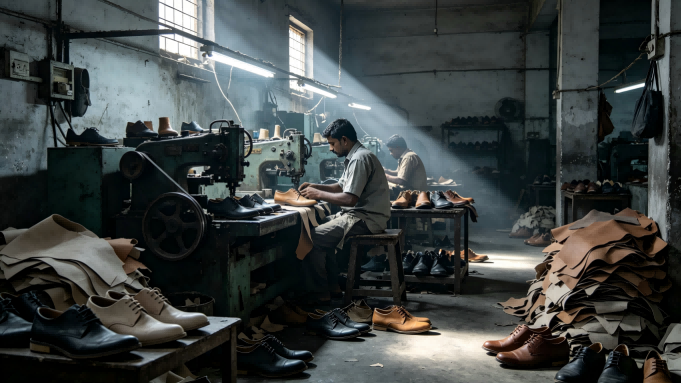
In today's deeply integrated global economy, localized geopolitical tremors regularly ripple through intricate modern supply chains, triggering profound downstream consequences for manufacturing sectors. Recently, sustained disruptions in Western Asian shipping and geopolitical landscapes have hampered capacity allocation along vital global energy and chemical feedstocks transit corridors. This chain reaction has extended its reach into South Asia, placing unprecedented upward cost pressures and severe supply chain bottlenecks on the Indian leather and footwear manufacturing industry.
As an established specialist in global chemical trade and modern supply chain integration, Wuxi High Mountain Hi-tech Development Co., Ltd. closely tracks material demand and order migrations across global consumer manufacturing sectors. Below is an in-depth analysis of the structural shifts, supply chain disruption risks, and potential realignments within global trade emerging from the South Asian shoe and leather industry.
Although the leather and footwear sector is traditionally viewed as a conventional manufacturing field, its reliance on modern petrochemical value chains is absolute. A vast array of fundamental shoe-making components—spanning synthetic leathers (PU), synthetic rubbers, diverse adhesives, thermoplastic rubbers (TPR) essential for outsoles, ethylene-vinyl acetate (EVA), and specialized leather chemicals—are direct derivatives of crude oil.
According to public assessments released by the Council for Leather Exports (CLE) of India, fluctuations in international crude oil and basic chemical material benchmarks caused by choked arterial shipping lanes have driven industry-wide manufacturing input costs up by 40% to 60%. This supply chain shockwave is primarily characterized by three compounding factors:
Escalating Petrochemical Feedstock Costs: Over the past several months, spot values for essential shoe materials like PU and TPR particles have logged substantial gains, directly pushing up rigid manufacturing floor costs by over 30%.
Spiraling Logistics and Insurance Premiums: Due to a sharp surge in risk premiums along Western Asian trade routes, container freight rates bound for the region have experienced exponential growth. Simultaneously, necessary route diversions have prolonged transit timelines and triggered matching escalations in insurance underwriting. For localized small-to-medium enterprises dependent on imported raw components and hardware, this freight spike has crushed remaining narrow profit margins.
Resistance to Cost Pass-Through by Global Buyers: Faced with rigid pricing limits imposed by overseas retail buyers, the headroom for shifting finished product pricing upward remains locked. Consequently, the commercial breathing room for contract manufacturing enterprises has contracted drastically, pushing many localized workshops to the brink of scaling down or pausing operations altogether.
The rapid transmission of this cost wave has materialized concretely along the assembly lines of primary industrial zones. Within major manufacturing clusters like Noida, premier outsole factories supplying international apparel and retail marques have slashed operational shifts due to erratic raw material arrivals, resulting in halved daily outputs. Among smaller operations heavily tied to specific TPR compound feedstocks, idle machinery rates remain conspicuously high.
Similarly, export sentiment in the major leather hub of Kolkata has faced tangible resistance. Financial data from the 2025–2026 fiscal cycle indicates that the country’s aggregate leather and product export revenues have entered a year-on-year decline. To counter this widespread material starvation, the Council for Leather Exports formally approached the Ministry of Commerce and Industry with urgent requests centered on securing temporary tariff waivers for critical imported intermediate goods, including:
Shoe components, wire, metallic trims, and technical production molds;
Crust leather, finished leather, and select fine leather chemicals;
Shoe linings, lasts, packaging materials, and shoe-making machinery.
This tactical push underlines a clear structural vulnerability: to offset expensive domestic manufacturing premiums, the regional footwear sector is increasingly reliant on securing duty-free access to external intermediate supplies just to maintain baseline operations.
Against a broader global macroeconomic backdrop where brands continuously hunt for stability, reliability, and cost-efficiency, the supply chain crunch hitting the Indian footwear sector is objectively accelerating the reallocation of global orders and procurement flows. This structural shift opens a distinct two-fold window of opportunity for Chinese industrial supply chains:
As South Asian suppliers face constrained capacity, extended delivery lead times, and uncompetitive compound quotes, mid-to-low-end footwear orders from European and American markets are migrating at an accelerated pace back toward mature coastal Chinese shoe-manufacturing clusters—such as Dongguan, Huizhou, and盖州 in South China, alongside Jinjiang and Wenzhou in East China. Backed by highly complete industrial ecosystems, rapid logistical execution, and stable domestic energy costs, China's footwear manufacturing base has re-emerged as a vital safe harbor for global brands seeking to hedge against geopolitical vulnerability.
Even as India’s finished footwear export engine faces structural headwinds, its domestic workshops require an increased reliance on upstream external supply chains to maintain low-level production runs. As a global manufacturing powerhouse for shoe components, metal trims, molds, heavy machinery, and fine leather chemicals, China is uniquely positioned to see its intermediate export volumes to South Asia expand over this period. When an industrial destination attempts to sustain factory floors via import substitution or local assembly, its underlying structural pull for high-quality, competitively priced Chinese intermediate goods experiences a rigid, compensatory rebound.

Mobile version


HOME | ABOUT US | PRODUCTS | NEWS | HONORS | FACTORY | CONTACT | 中文版
Copyright(C)2025, Wuxi High Mountain Hi-tech Development Co., Ltd. All Rights Reserved. Supported by Sunsirs ChemNet Toocle Copyright Notice 备案序号:苏ICP备2025195488号